EXHIBITED
GLIMMER
A wildwoman, doubled faces and beauty with teeth: GLIMMER brings intimate surrealism to San Francisco’s Modern Eden Gallery.
COUTEUR EDITORIAL
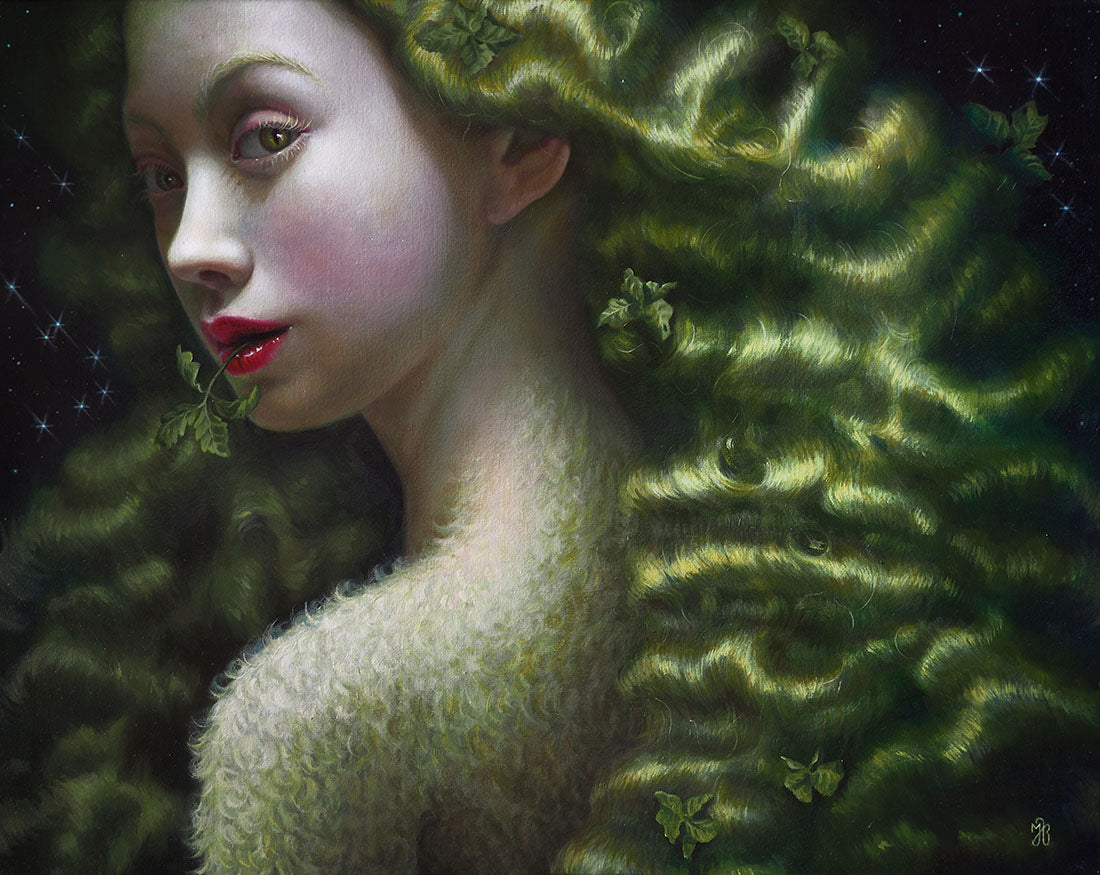
Jana Brike’s woman is not waiting to be rescued from the dark. She belongs to it. In Wildwoman and the Shining Darkness, a turned head, red lips and a pale, fur-covered shoulder emerge from a green world threaded with light. The portrait gives femininity something more interesting than immaculate composure: instinct. It is a fitting entrance to GLIMMER, the forthcoming group exhibition at Modern Eden Gallery in San Francisco. Here, beauty does not promise to make everything easier. It makes looking harder to give up.
Curated by Beautiful Bizarre Magazine, GLIMMER opens November 7, 2026, with a reception from 6–9 PM, and continues through January 7, 2027. This is Modern Eden’s sixth exhibition with the magazine, organised around intimate moments of connection, pleasure and safety. Those words sound gentle. The images are less obedient. Faces multiply; hair becomes a veil; birds hover close enough to unsettle a sleeping figure. The appeal is not a uniform dreaminess, but the friction between comfort and strangeness. A glimmer needs darkness to become legible.
Brike’s oil-on-canvas painting establishes that friction before we reach the first paragraph. Her figure’s fur complicates the familiar polish of the painted female portrait, while the curling green surroundings make wildness feel like a habitat rather than a costume. There is glamour in the red mouth, but it does not domesticate the body. The work’s force lies in allowing those impressions to coexist. She can be poised and untamed. The image does not ask us to resolve the contradiction for her.
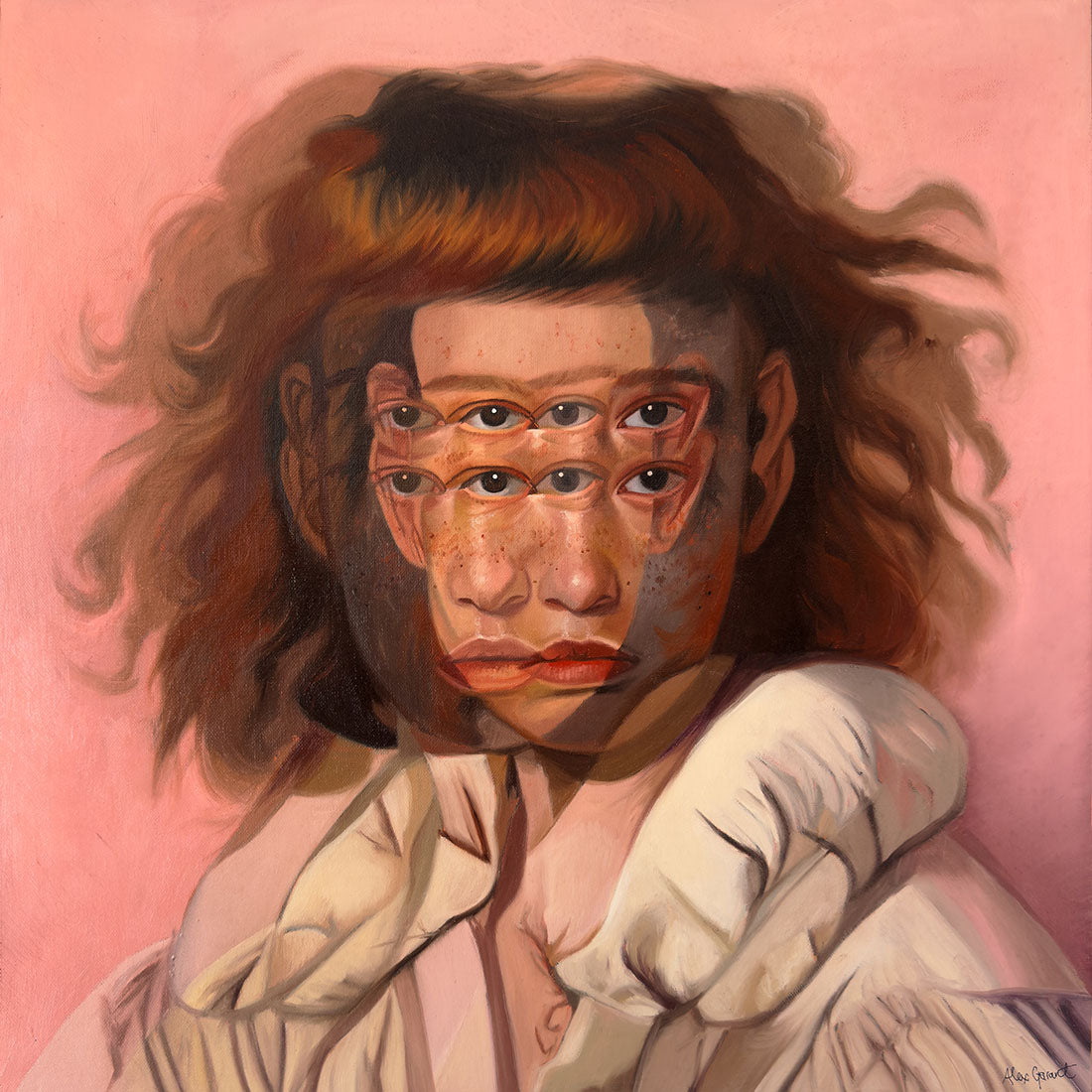
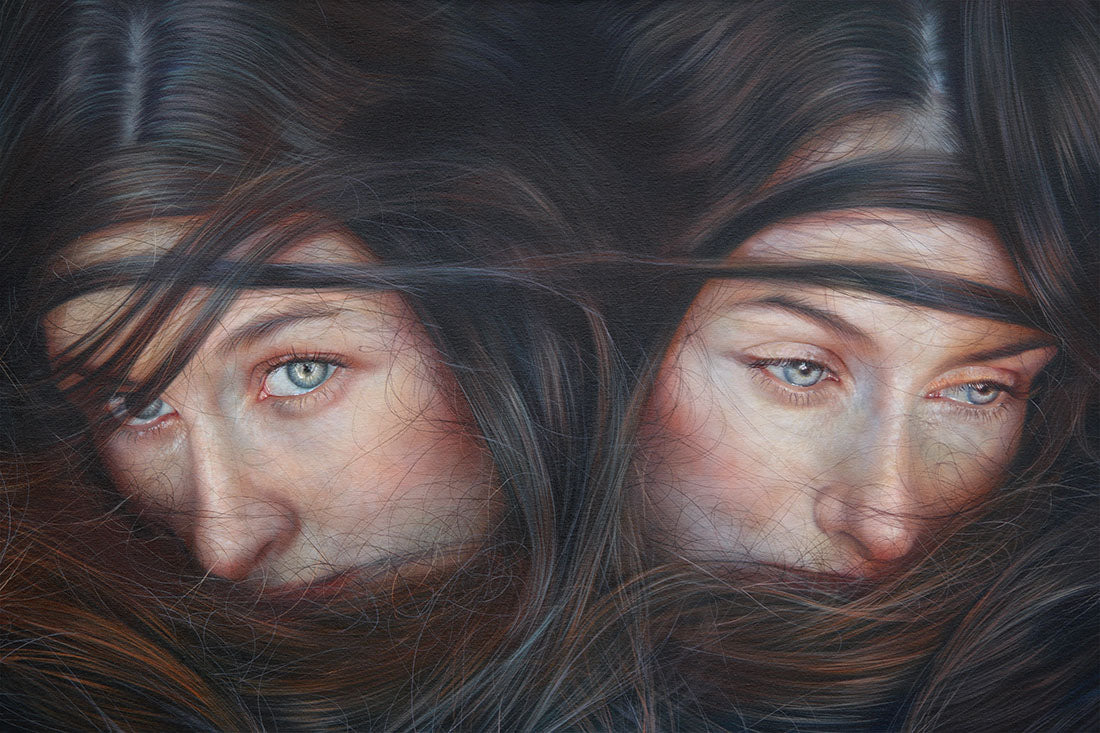
Alex Garant and Roos van der Vliet make the face a similarly unstable territory. In Garant’s Magie, repeated eyes disturb an otherwise composed portrait on a pink ground. The doubling turns recognition into an effort: we know the shape of a face, yet cannot settle comfortably inside this one. Van der Vliet’s Ultra Tempus draws two faces into a sweep of dark hair. Acrylic on canvas becomes a study in partial access, with eyes emerging from a surface that conceals as insistently as it reveals. Neither portrait lets beauty remain passive.
“Beauty is most interesting when it keeps something back.”
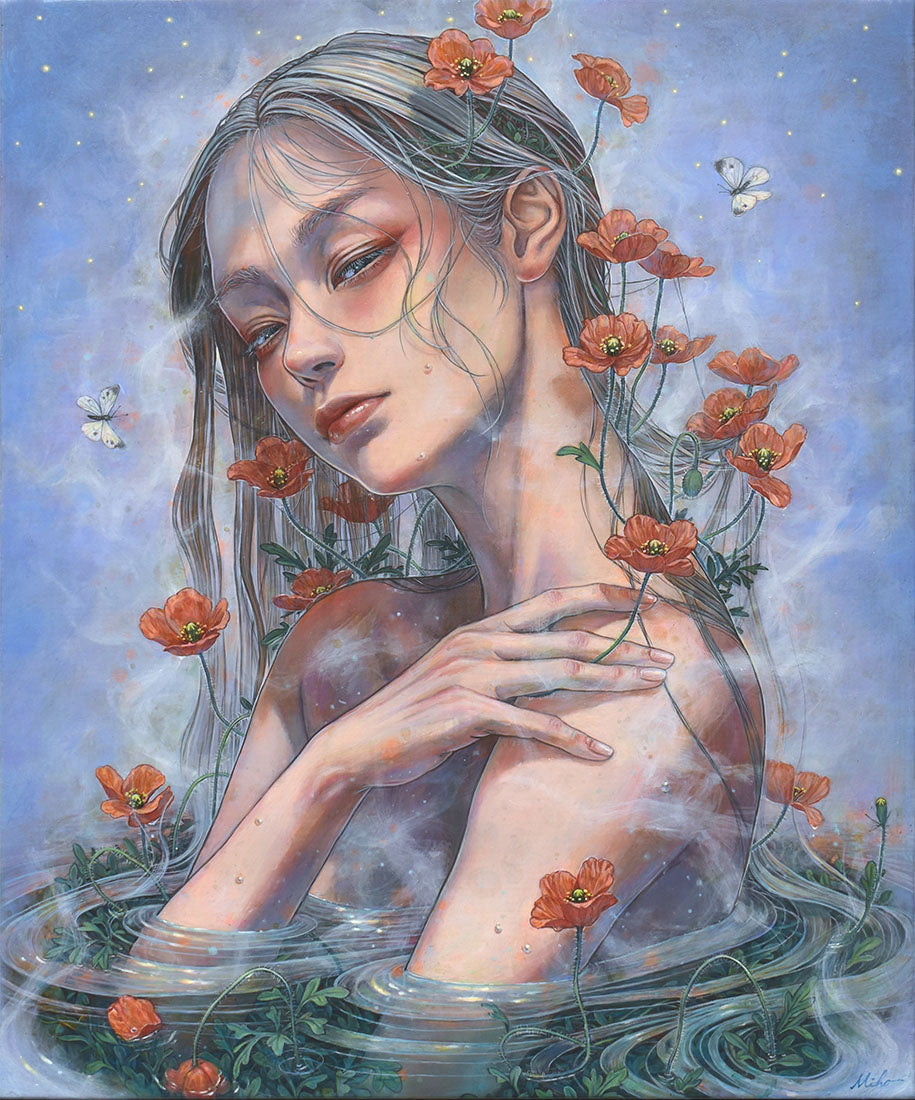
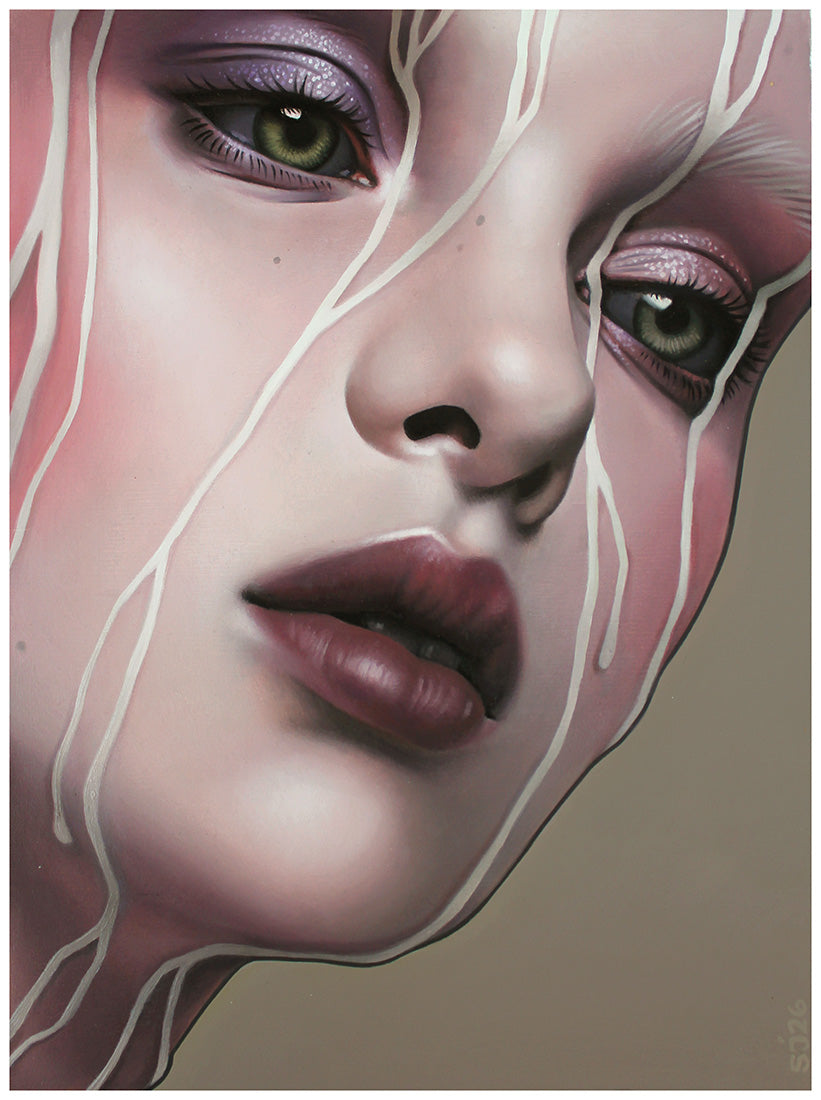
Miho Hirano’s A Moment for Myself moves from optical disturbance toward suspension. Orange flowers surround a figure whose shoulder and hands meet a watery blue field; the composition feels permeable, as though the body and its environment have stopped observing separate borders. Sarah Joncas brings us abruptly closer in Overtaken, painted in oil and acrylic on panel. Pale strands cross an enlarged face, interrupting its cool green-eyed gaze. The contrast is productive: Hirano opens the portrait into atmosphere, while Joncas makes atmosphere feel like something passing directly across the skin.
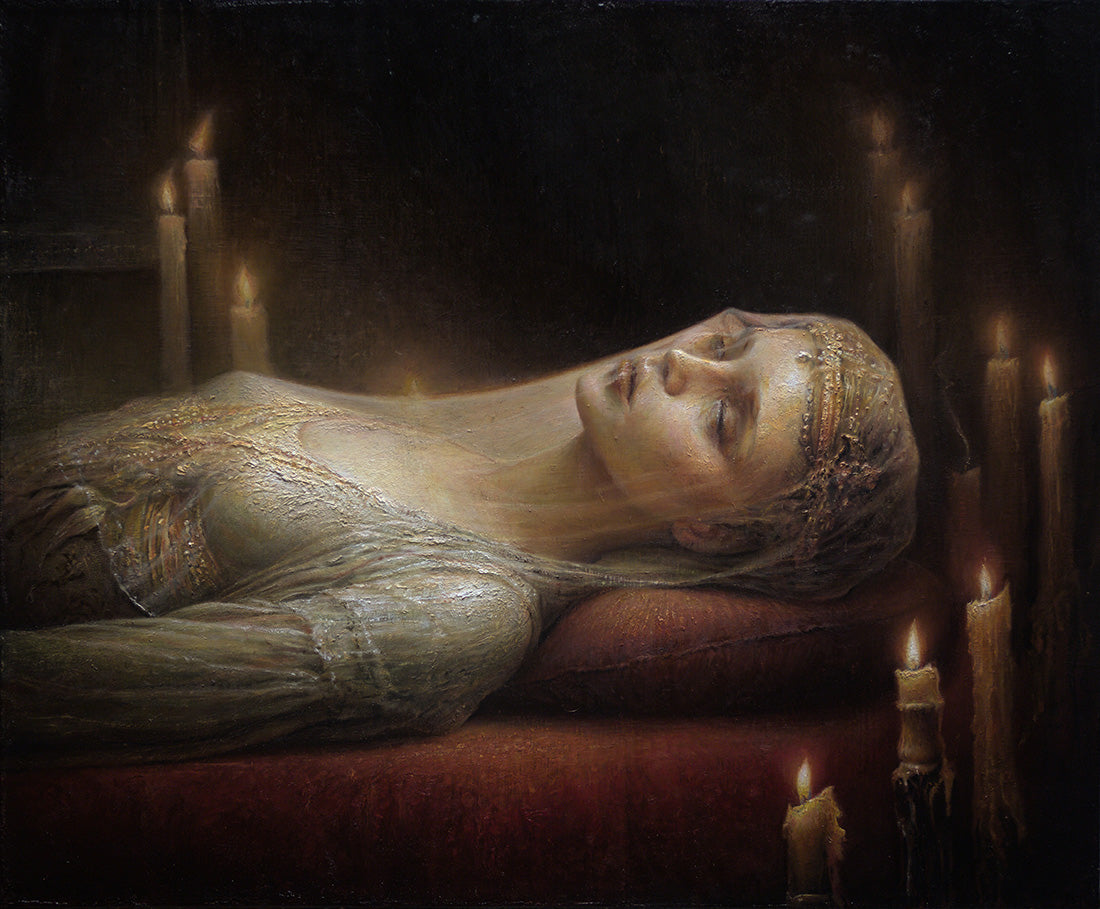
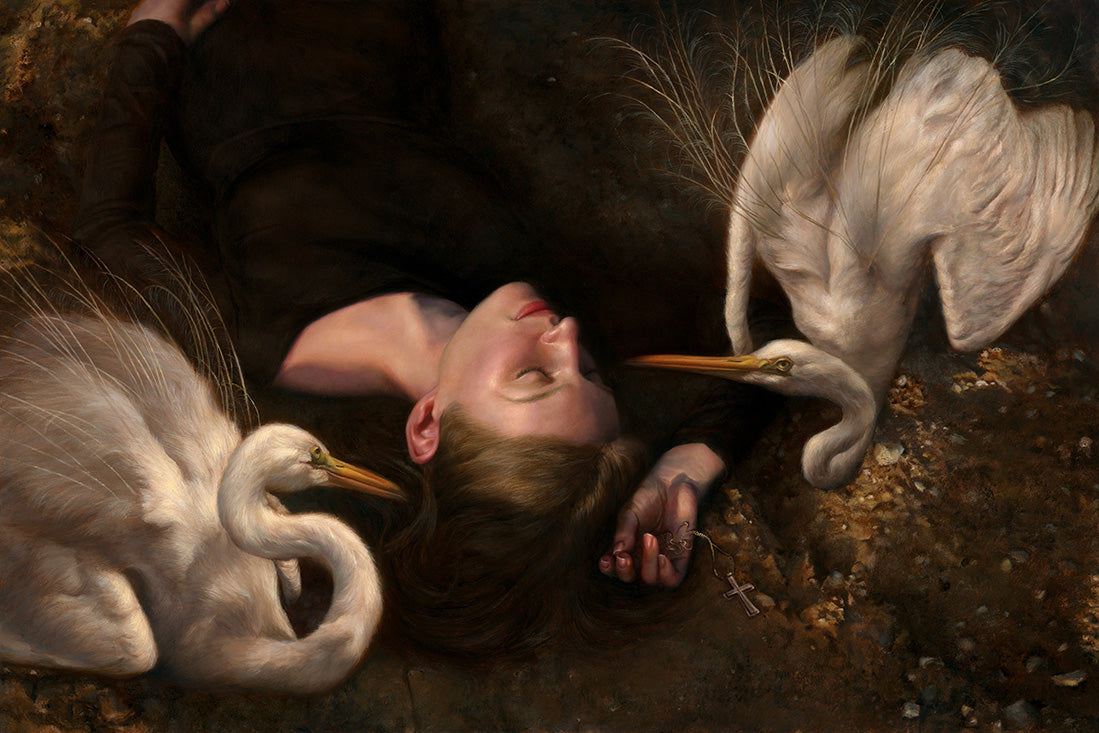
Luke Hillestad’s Talia and Felicia Feldman’s Guardians II give stillness a darker charge. Hillestad places a reclining figure among candles, the warm points of light marking out a space that seems held apart from everyday time. The oil-on-linen painting makes quiet feel ceremonial. In Feldman’s oil-on-panel work, pale birds gather around another reclining body, their curved necks and open beaks refusing the easy sweetness of an animal companion. Protection and intrusion become difficult to separate. Safety, in these images, is not an empty room; it has watchers.
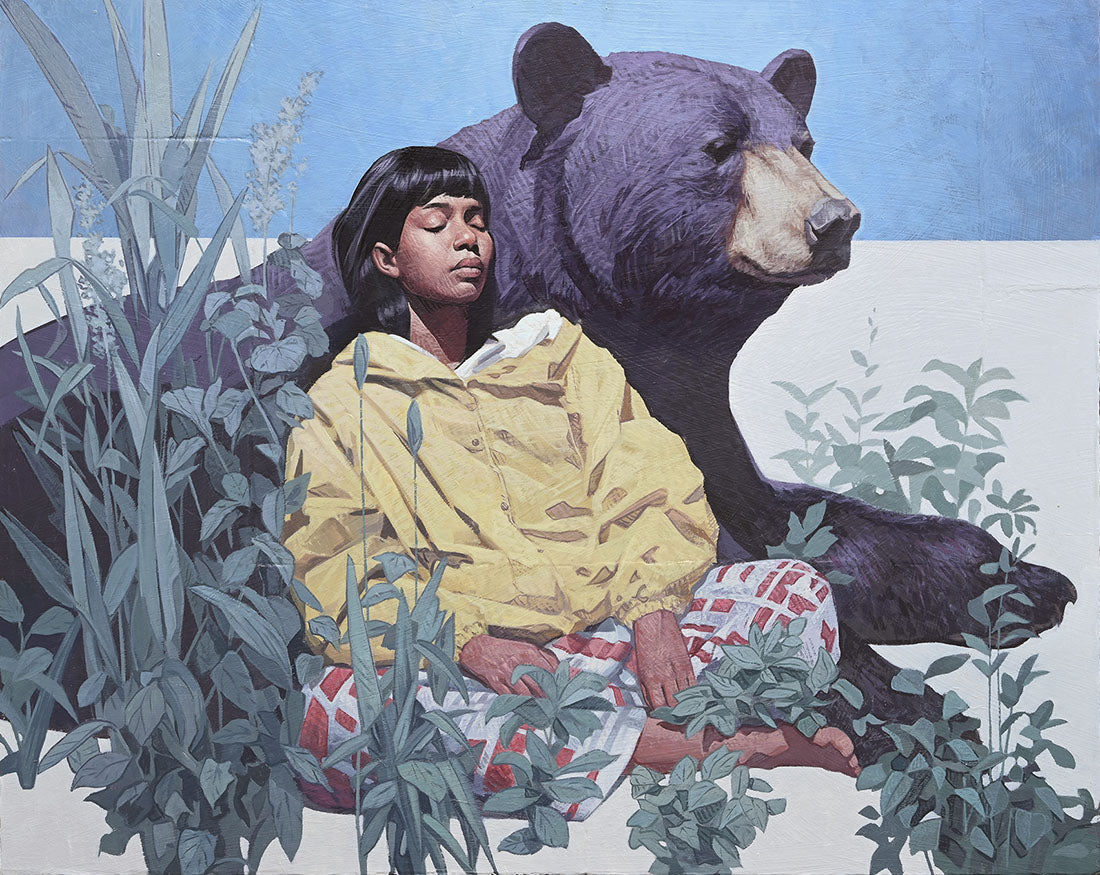
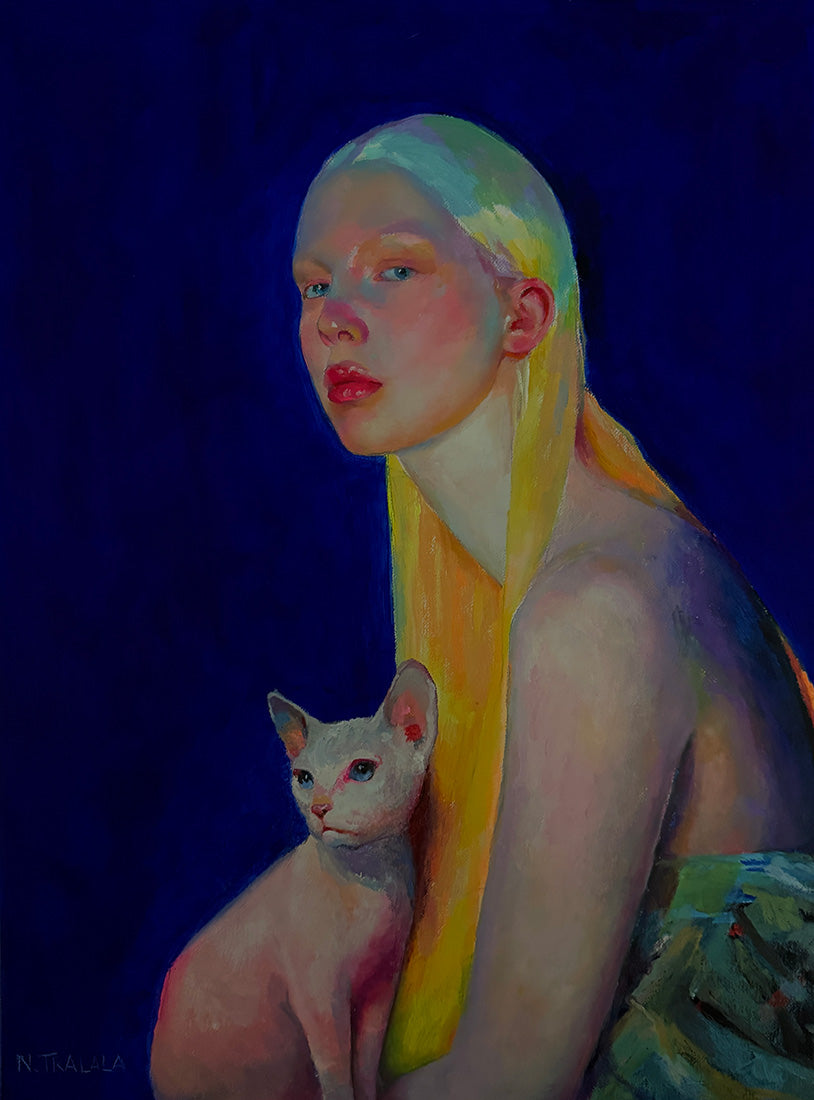
Kevin Peterson’s Dreamy offers a different kind of companionship. A child in a yellow jacket rests beside a bear among blue foliage, the animal’s weight lending gravity to the scene’s tenderness. Nadine Tralala’s Eo makes the encounter more electric: a pale figure and a small cat emerge against an intense blue ground, touched by yellow and pink. Peterson constructs closeness through shared stillness; Tralala lets colour carry the emotional temperature. Neither image needs a reassuring smile. The relationship is already present in how the bodies occupy the frame.
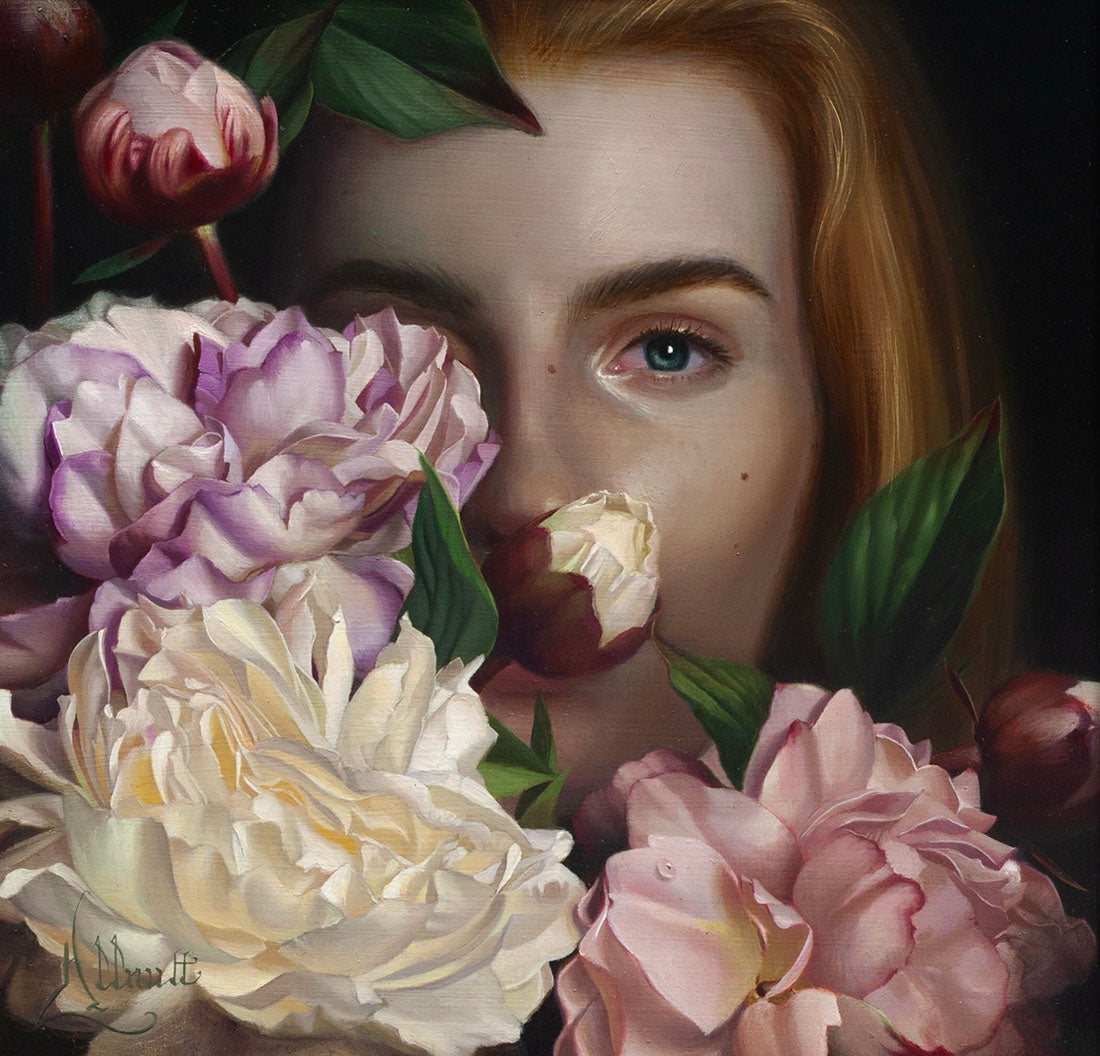
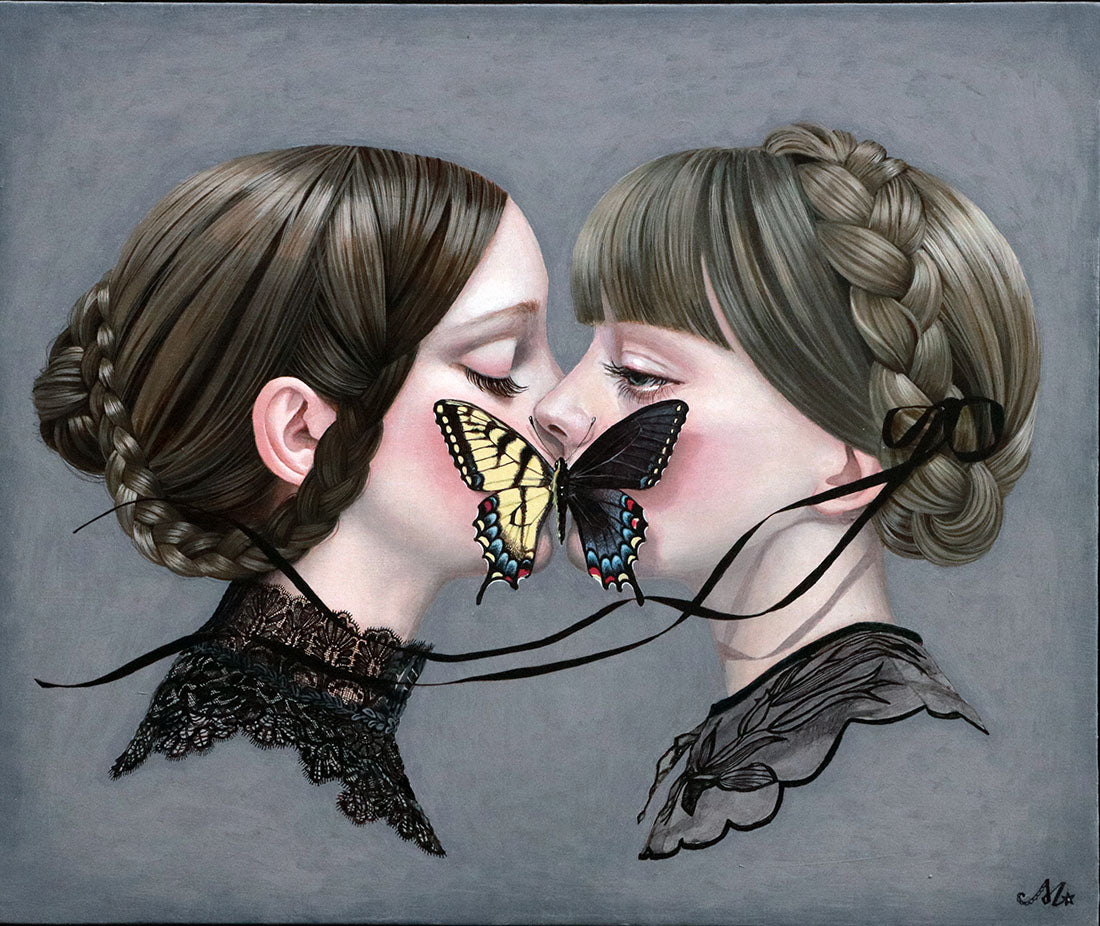
Mao Hamaguchi’s Glimmer Between brings two profiles almost mouth to mouth, with a butterfly interrupting their meeting. Its wings turn the space between faces into the picture’s most active point. Jennifer Allnutt’s Obscure uses flowers to perform another interruption: peonies crowd a face until one visible eye becomes an anchor for the whole composition. In both works, an exquisite detail prevents complete access rather than delivering it. Beauty is most interesting when it keeps something back. The flower and the butterfly are not decorative afterthoughts; they decide how we look.
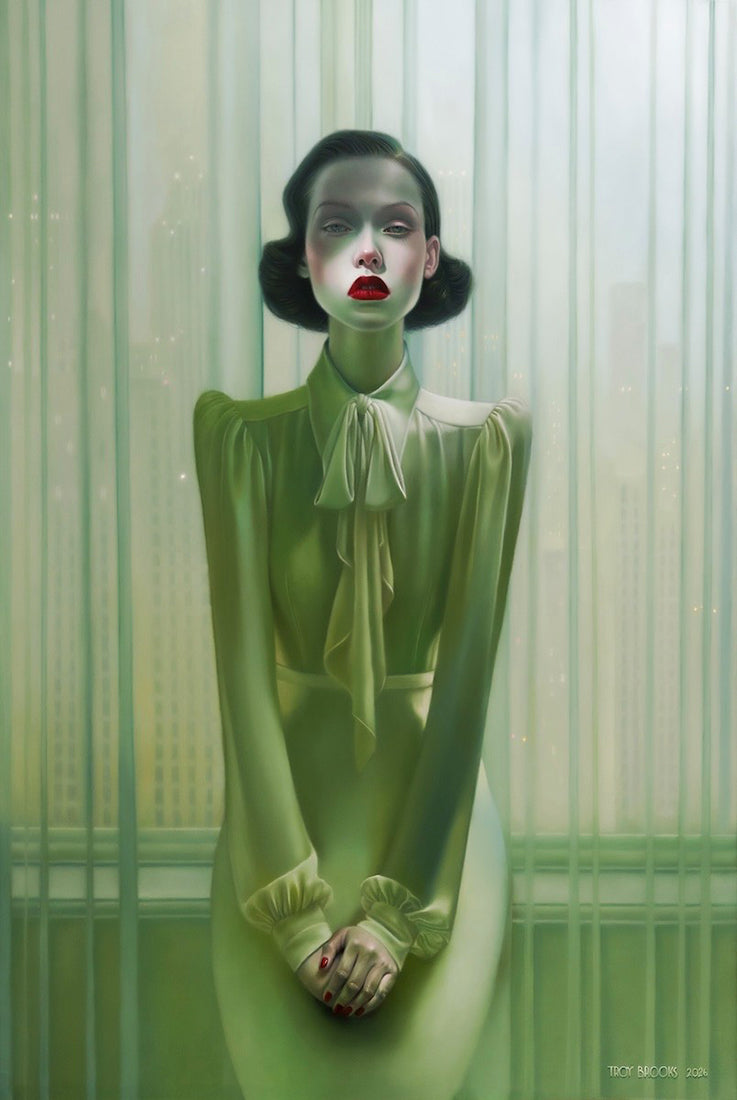
Troy Brooks changes the temperature again in The Remnant. An elongated green-clad figure stands before pale vertical lines, its red mouth a small, sharp interruption in a tightly controlled palette. The painting’s elegance is inseparable from its unease. That long silhouette and disciplined setting make theatricality feel precise, not lavishly indiscriminate. Beside the warmer encounters elsewhere in GLIMMER, it gives the exhibition’s emotional vocabulary an edge. Pleasure can be cool. A compelling figure does not have to welcome us in order to hold our attention.
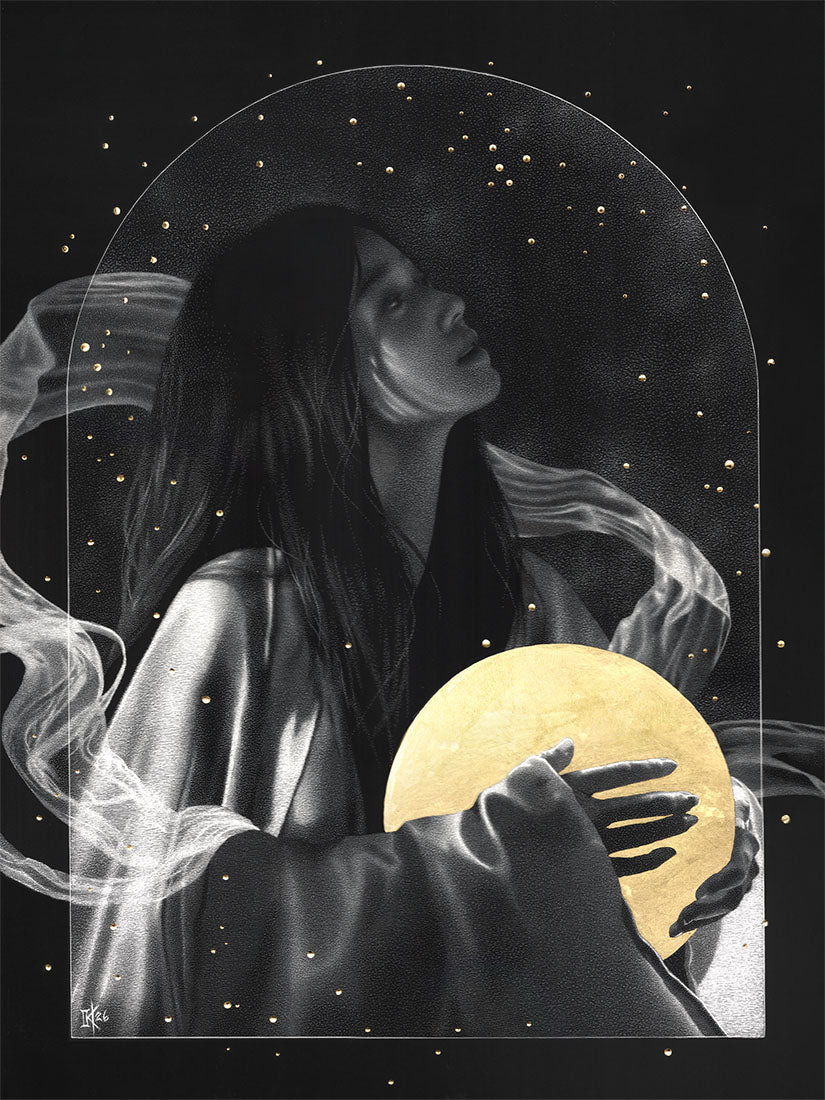
Kate Adams and Patrick Kramer return the conversation to light itself. Adams’s Amaterasu pairs scratchboard with 23k gold leaf, setting a golden disc against smoke and blackness. Drawn illumination and reflective material belong to different physical registers; the object has something the screen cannot fully deliver. Kramer’s The Light Between gathers sculptural figures above candle flames in a wooded dark. Their apparent permanence meets a light that could disappear. Both works make brightness local rather than total. The dark is not defeated; it gives the luminous detail its consequence.

Taken together, these advance images suggest an exhibition with room for distinct kinds of intimacy. A multiplied gaze is not the same experience as a sleeping body or a shared animal presence. That difference is worth preserving. GLIMMER becomes interesting when its premise permits tension, rather than smoothing every artist into one reassuring mood. This is a preview, not an account of the installation. The paintings already give us plenty to anticipate: particular surfaces, charged encounters and an attention to what an image chooses to withhold.
At Modern Eden, 1100 Sutter Street, San Francisco, GLIMMER runs from November 7, 2026, through January 7, 2027; the opening reception is November 7, 6–9 PM. Go for Brike’s wildwoman. Stay for the faces that will not stabilise, the birds that might be guardians, the flower that blocks the eye. The most persuasive beauty here is not an escape from complexity. It is a reason to remain with it. Some paintings light up a room. These ask what we can see once our eyes adjust.